




Prediction markets are the fastest-growing corner of American betting. Instead of taking odds from a bookmaker, you trade event contracts — simple yes/no positions on what will happen next in sports, politics, the economy and culture — on exchanges regulated by the federal Commodity Futures Trading Commission (CFTC). Since the 2024 election cycle pushed them into the mainstream, volumes have exploded: the category leader alone handled close to $40 billion in trading in the year to early 2026. This guide explains how prediction markets work, how they differ from a sportsbook, where they’re legal in June 2026, and which are the best prediction market apps for each type of trader.
What is a prediction market?
A prediction market is an exchange where people buy and sell contracts tied to the outcome of a real-world event. Each contract is a yes/no question — “Will the Chiefs win the Super Bowl?”, “Will the Fed cut rates in July?”, “Will the S&P 500 close higher today?” — and trades at a price between 1¢ and 99¢. That price is the market’s implied probability: a contract trading at 29¢ means traders collectively see a 29% chance. If you’re right, each contract settles at $1.00; if you’re wrong, it settles at $0.00. You can also sell your position before the event resolves, locking in a profit or cutting a loss, much like cashing out a live bet.
Prediction markets vs sportsbooks: the key differences
Prediction markets look like betting, but legally and mechanically they’re closer to a stock exchange. The main differences:
- Regulator: Prediction markets are overseen federally by the CFTC; sportsbooks are licensed state by state.
- Minimum age: Most prediction markets allow 18+, versus 21+ at licensed sportsbooks.
- Pricing: You pay a probability (1–99¢) rather than American odds, and the “vig” is typically a small per-contract fee instead of the 5–10% margin baked into sportsbook lines.
- Counterparty: You trade against other users (peer-to-peer), not against the house.
- Availability: Because they’re federal, prediction markets can reach states with no legal sportsbook — including California, Texas, Florida and Georgia.
How to use a prediction market app
- Sign up and verify. Create an account (18+) and complete identity verification.
- Fund your account. Most apps take debit/credit cards and bank transfers; crypto-native platforms use USDC.
- Pick a market. Browse by category — sports, politics, economics, culture — and read the resolution rules.
- Buy Yes or No. The price is the implied probability; a winning contract pays $1.00.
- Hold or trade out. Sell before resolution if the price moves your way, or hold to settlement.
The best prediction market apps for 2026
We rank prediction market apps on regulation and safety, market depth, fees, ease of use and how reliably they pay. These are the top five for 2026.
Kalshi — best fully regulated platform
Kalshi is the most established U.S. prediction market and the first to hold a CFTC Designated Contract Market license (granted 2020). It handled roughly $39.7 billion in trading in the year to early 2026, about 87% of it on sports, and offers dollar-funded markets to traders 18 and up. Its new-user offer is a modest “trade $10, get $10” bonus, with referrals worth up to $1,000. Valued near $22 billion in 2026, it’s the cleanest regulated on-ramp for most Americans — though its sports contracts are the focus of the sector’s biggest legal battles.
Robinhood — best for beginners
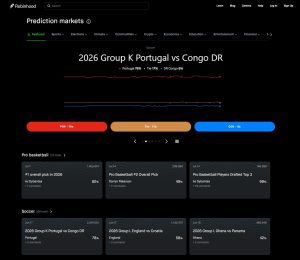
Robinhood bolts prediction markets onto the app millions already use for stocks and crypto, so there’s no new account to open. Contracts are offered through Robinhood Derivatives (CFTC-registered) and listed via Kalshi, with a flat, transparent fee of just $0.02 per contract. The simplified interface — pick a side, see a price, buy — makes it the easiest entry point, and volume is enormous (about 2.6 billion contracts in December 2025 alone). Event contracts are available in all 50 states, though sports contracts are excluded in Maryland, New Jersey and Nevada.
DraftKings Predictions — best new mainstream app
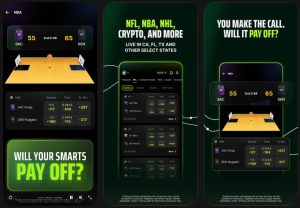
DraftKings launched its standalone Predictions app in December 2025 and went wide fast: it’s live in 38 states, including sports markets in California, Florida, Georgia and Texas, where no legal sportsbook exists. It runs as a CFTC-regulated front end through CME Group and its own newly acquired Railbird exchange, with customer funds custodied at Wedbush Securities. Backed by DraftKings’ huge sports audience and ESPN/NBCUniversal ties, it added sports-contract combos (parlays) in 2026. It’s the most familiar option for existing sports bettors expanding into event contracts.
Polymarket — best-rated crypto prediction market
Polymarket is the crypto-native heavyweight, famous for its 2024-election forecasting and deep liquidity on global and political events. After three years shut out of the U.S., it bought the CFTC-licensed QCX exchange and relaunched stateside in December 2025, opening its iOS app nationwide in May 2026. It settles in USDC and carries no traditional welcome bonus or promo code. A $2 billion investment from ICE (the owner of the NYSE) pushed its 2026 valuation to roughly $15 billion, cementing its move from crypto startup to institutional exchange.
FanDuel Predicts — best for sports predictions
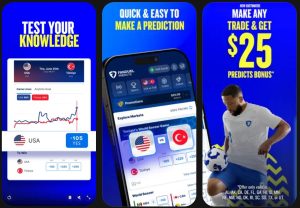
FanDuel’s event-markets app, built with CME Group, launched on December 22, 2025 and is rolling out state by state. Its core menu covers financial benchmarks (the S&P 500, Nasdaq-100, oil and gas) and cultural events, plus sports contracts across baseball, basketball, football and hockey — but only in states without legal online sports betting, never on tribal lands, and removed once a state legalizes betting. Backed by FanDuel’s market-leading sports brand and Flutter Entertainment, it’s the natural pick for sports-minded traders in non-betting states. Responsible-gaming tools and Kindbridge support are built in.
Best prediction market by category
The “best” app depends on what you want to trade. Here’s how the leaders stack up by category.
Best for politics and elections
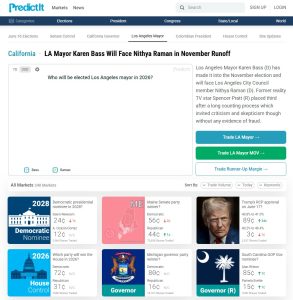
Polymarket and Kalshi dominate political markets on depth and breadth, while PredictIt remains a long-running, politics-only research market for election and policy contracts.
Best for football and sports
FanDuel Predicts and DraftKings Predictions lead on sports, especially in states with no legal sportsbook; Kalshi and Robinhood also list major sports contracts (subject to state restrictions).
Best for economics and finance
Kalshi pioneered Fed, CPI and economic contracts, and FanDuel Predicts leans heavily on CME’s financial benchmarks like the S&P 500 and Nasdaq-100.
Best for beginners
Robinhood, thanks to its stripped-down interface, in-app integration and flat $0.02 fee.
Best for crypto users
Polymarket, which is USDC-settled and built on blockchain infrastructure.
Live market examples
To see how contracts work in practice:
- Sports: “Will Los Angeles win the World Series?” In June 2026, LA traded around a 29% implied probability on Kalshi. Each team has its own yes/no contract, so prices across the field don’t sum to exactly 100%.
- Politics: “Will the Senate confirm Nominee X by July 31?” — a binary contract that pays $1.00 to the correct side at resolution.
- Economics: “Will the Fed cut rates at its next meeting?” or “Will the S&P 500 close above a set level today?” — the financial markets that anchor Kalshi and FanDuel Predicts.
Are prediction markets legal in the US?
Mostly yes — but it’s the most contested question in betting right now, and the answer depends on the market type and your state.
The federal picture (allowed)
Prediction markets operate under the CFTC, which claims “exclusive jurisdiction” over event contracts traded on a regulated exchange. On that basis, the major platforms treat non-sports markets (politics, economics, weather, culture) as legal nationwide for anyone 18 or older. That federal footing is exactly why these apps can serve states with no legal sportsbook.
Where sports contracts are restricted or pending (as of June 2026)
Sports event contracts are the flashpoint. States argue they’re unlicensed gambling; the platforms argue they’re federally regulated swaps. The courts have split:
- Restricted / blocked: Nevada (a court restraining order against Kalshi’s sports, entertainment and election contracts) and Massachusetts (a state court barred Kalshi’s in-state sports contracts). Robinhood does not offer sports contracts in Maryland, New Jersey or Nevada.
- Federal wins for the platforms: The Third Circuit affirmed an injunction (April 2026) barring New Jersey from enforcing its gambling laws against Kalshi’s sports contracts, and a federal court in Tennessee sided with Kalshi on preemption.
- Pending / contested: The U.S. government and CFTC filed suits in Illinois, Connecticut and Arizona (April 2026) defending federal jurisdiction; Wisconsin sued several operators (and the CFTC countersued the state); California tribes sued Kalshi and Robinhood over tribal-land access; and Minnesota advanced a bill to ban prediction markets outright. The CFTC has also opened rulemaking on what counts as “gaming.”
Because the landscape shifts month to month and may ultimately reach the Supreme Court, always check what’s live in your state inside the app before funding an account.
Top prediction market apps at a glance
- Kalshi — best fully regulated platform (CFTC, 18+, dollar-funded)
- Robinhood — best for beginners ($0.02/contract, inside the Robinhood app)
- DraftKings Predictions — best new mainstream app (38 states, incl. CA/TX/FL/GA)
- Polymarket — best-rated crypto prediction market (USDC, deep political liquidity)
- FanDuel Predicts — best for sports predictions (CME-powered, finance + sports)
Frequently asked questions
1. What is the best prediction market app in 2026?
For most U.S. traders, Kalshi is the best all-round choice as the most established, fully CFTC-regulated, dollar-funded exchange. Robinhood is best for beginners, Polymarket for crypto users and political depth, and FanDuel Predicts or DraftKings Predictions for sports in non-betting states.
2. Are prediction markets legal in the US?
Yes, prediction markets run on CFTC-regulated exchanges and are broadly legal nationwide for traders 18+. The exception is sports event contracts, which several states are challenging in court.
3. Which states are prediction markets banned or restricted in?
As of June 2026, sports contracts are restricted in Nevada and Massachusetts, and certain platforms exclude sports in Maryland and New Jersey. Cases are pending in Illinois, Connecticut, Arizona, Wisconsin and California, and Minnesota has proposed a ban. Non-sports markets remain widely available.
4. Do you have to be 21 to use prediction markets?
No. Because they’re regulated as financial exchanges rather than sportsbooks, most prediction markets allow users 18 and older — a key difference from licensed sports betting, which requires 21+.
5. Are prediction market winnings taxed?
Generally yes. Profits from event contracts are taxable, and some platforms (such as Robinhood) provide 1099 tax forms. Treatment can differ from sports-betting winnings, so keep records and consult a tax professional about your situation. This is not tax advice.
6. Are prediction markets the same as sports betting?
No. You trade yes/no contracts against other users on a federally regulated exchange, paying an implied probability plus a small fee — rather than taking odds from a sportsbook that builds in a larger margin.
7. Which prediction market has the lowest fees?
Robinhood is among the cheapest at a flat $0.02 per contract. Kalshi and Polymarket charge per-transaction fees; PredictIt is the most expensive, at 10% on profits plus 5% on withdrawals.
8. Can you actually make money on prediction markets?
Yes — correct contracts settle at $1.00 and you can sell winning positions early. But prices reflect real probabilities and fees apply, so there’s genuine risk of loss; never trade more than you can afford to lose.
9. What’s the difference between Kalshi and Polymarket?
Kalshi is dollar-funded, U.S.-regulated and has been continuously available to Americans; Polymarket is USDC-funded, crypto-native and only returned to the U.S. in late 2025, often with deeper liquidity on big political and global events.
10. Do prediction markets offer bonuses or promo codes?
Mostly no. Kalshi offers a small “trade $10, get $10” credit; the others generally have no traditional welcome bonus or promo code. Be cautious of sites advertising big “prediction market bonus codes.”