






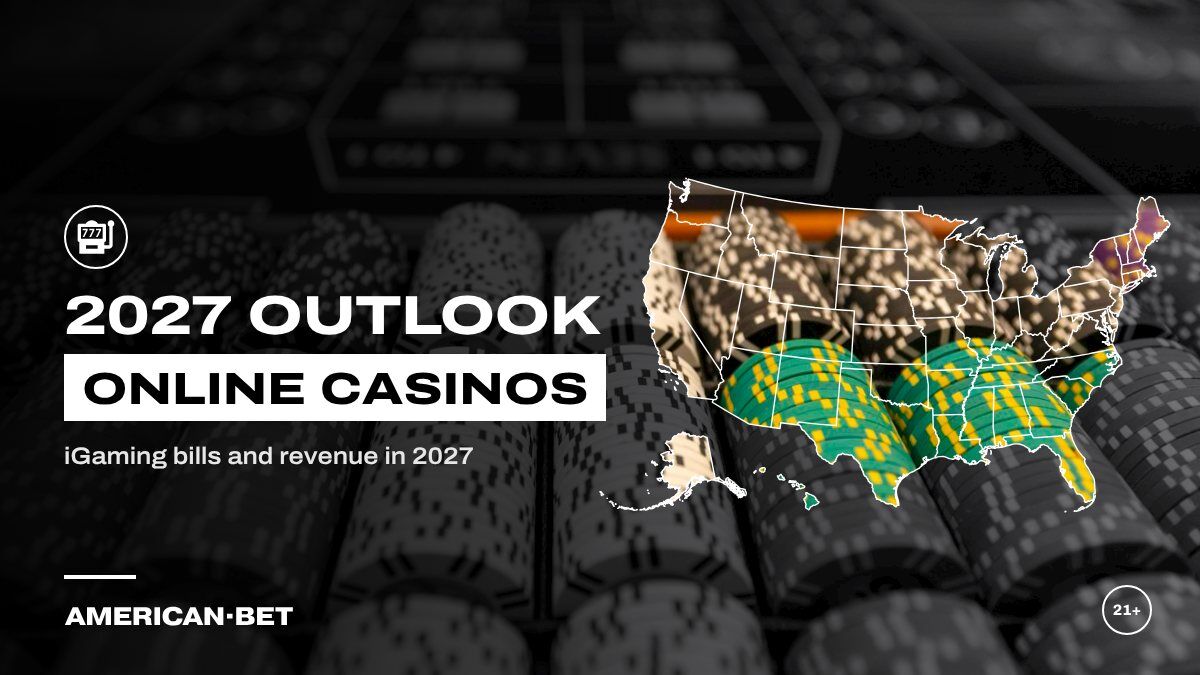
Legal online casinos had the best year in their short American history in 2025, and almost no state wanted to join the party. That gap between booming revenue and frozen legislatures is the defining story of iGaming right now. Our read is that 2027 brings one genuine new market, one or two serious near misses, and a lot more of the same argument.
In this article 6 sections
Online casino revenue: the 2025 numbers that frame 2027
Start with the scale. According to the American Gaming Association’s annual State of the States figures, as reported by CDC Gaming, US commercial gaming produced a record of nearly $79 billion in 2025. iGaming accounted for $10.7 billion of that, up 27.6% year on year, and generated $2.6 billion in taxes, up 36.9%. Traditional casino gaming grew just 2.3%.
The state regulators tell the same story in finer detail.
- Pennsylvania: The Pennsylvania Gaming Control Board’s year-end 2025 report put iGaming revenue at $2.78 billion, up 27.22%. Slot machine revenue slipped 0.62% to $2.43 billion, which means online play now out-earns the state’s slot floors. See our Pennsylvania online casino guide for the licensed operators.
- New Jersey: The Division of Gaming Enforcement’s December 2025 release showed Internet Gaming Win of $2.91 billion for the year, up 22.0%. In-person casino win was $2.89 billion, up 2.7%. Across the full calendar year, New Jersey’s online casinos edged out Atlantic City’s physical gaming floors. Our New Jersey online casino page tracks that market.
- Michigan: The Michigan Gaming Control Board reported $3.1 billion in 2025 iGaming gross receipts and $2.9 billion in adjusted gross receipts, with $597.5 million in taxes and fees to the state and $152.6 million to Detroit. December alone set a monthly record of $315.8 million in gross receipts.
Those three states, alongside West Virginia, Connecticut, Delaware and Rhode Island, make up the seven live markets. That is a small club for an industry that now rivals sports betting in tax yield per state.
Maine becomes the eighth iGaming state, but not yet a live one
The one addition since 2024 is Maine. LD 1164, which gives the four Wabanaki Nations exclusive online casino rights, passed the House 85-59 in June 2025, with 16% of revenue directed to the state for addiction services, housing relief and veteran housing. Oxford Casino and Hollywood Casino Bangor opposed it, arguing it created a tribal monopoly that would divert their revenue.
Gov. Janet Mills let the bill become law without her signature in January 2026. As of a July 2026 Action Network update, no platform was live. Each tribe can partner with one operator, for a maximum of four, and three have signed with Caesars Entertainment. The Maine Gambling Control Unit is still writing rules, and the same report called early 2027 a more likely launch window than late 2026. We agree. Track progress on our Maine page.
Maine’s market will be small. Its importance is the model: a tribal-exclusive structure that sidesteps the commercial casino lobby by handing the product to sovereign nations. Expect lawmakers in other tribal-gaming states to study it closely.
Why iGaming bills keep failing in the statehouse
The 2026 session was another wipeout. Here is how it played out in the states that mattered most.
New York: the governor problem
Sen. Joe Addabbo’s Senate Bill 2614 never reached a vote. The Lines reported that Addabbo shelved it because, without Gov. Kathy Hochul’s backing, he did not believe it could survive a veto. Democrats would be one vote short of an override in the Senate. Addabbo projects $475 million a year from iGaming, against a three-year deficit projection of $34 billion from Comptroller Thomas DiNapoli. Hochul is favored for re-election, and that publication noted a long wait is possible if she wins. Addabbo is expected to file again in 2027, his fifth year running.
Virginia: closest to the line
Virginia came nearest. Covers reported that the House and Senate each passed bipartisan iGaming bills but never reconciled them. The plan would have let the state’s five retail casinos partner with up to three online operators each, for as many as 15 platforms. Concerns about addiction, casino jobs and how tax money would be split sank it. Sen. Jeremy McPike also raised a capacity question: “do you have the infrastructure and staffing to stand up a new market and regulate it.” Separate legislation would move gaming oversight from the lottery to a new Virginia Gaming Commission, and our read is that the commission question has to be settled before iGaming can pass.
Maryland and Illinois: running out the clock
In Maryland, two bills that would have put online casinos to voters in November failed to advance, per PokerNews, and the sponsor withdrew the referendum proposal in March. Massachusetts stalled too.
Illinois keeps filing and keeps losing. Rep. Edgar Gonzalez Jr.’s HB 4797, the Internet Gaming Act, returned for 2026 with a 25% tax, up to three skins per casino, and a clause denying license renewal to operators that cut 25% or more of their workforce. The 2023, 2024 and 2025 versions all died without a committee vote, opposed by retail casinos and video gaming terminal operators. Meanwhile the legislature’s attention went elsewhere: Rep. Bob Rita’s HB5034 deals with sports wagering licenses and sits in House Rules.
The cannibalization fight behind every failed bill
Every stalled bill above has the same opponent in the room: land-based casinos and their workers. The data is genuinely contested.
On one side, an Eilers & Krejcik Gaming study commissioned by trade group iDEA Growth found land-based casinos in six iGaming states saw a 2.44% quarterly revenue boost after online legalization, and that declines in mature retail markets flattened more often where iGaming existed. On the other, the National Association Against iGaming, backed by executives at Red Rock Resorts, Cordish Companies and Churchill Downs, cited an Innovation Group study linking online gaming to a roughly 16% decline in retail casino revenue, and projected retail losses of about $984 million in New York, $545 million in Illinois, $523 million in Ohio and $343 million in Maryland.
Both studies were paid for by interested parties. The regulator numbers are more neutral, and they are mixed. Pennsylvania slots dipped slightly while iGaming soared. Atlantic City’s in-person win still grew 2.7%. Our read: iGaming is not destroying retail casinos, but it is capturing nearly all the growth, and in a statehouse that distinction loses to a union hall full of worried dealers.
What to expect in 2027
- Maine is likely to go live. With rules still being drafted and three tribal deals signed with Caesars, we expect the first Maine platforms to launch in the first half of 2027.
- Virginia is the likeliest new legalization. Both chambers have already passed versions once. If lawmakers settle the gaming commission question first, we think a reconciled bill has a real shot.
- New York stays shut unless Albany changes. With Hochul favored and no override math in the Senate, we expect SB 2614’s successor to stall again.
- Illinois probably files for a fifth time and fails again. Nothing in the VGT and retail opposition has shifted, and the workforce clause has not won them over.
- Maryland returns to the referendum idea. Withdrawal in March 2026 looks like a reset, not a retreat, and we expect a ballot-question bill to be refiled.
- Revenue keeps compounding. With 27% growth in Pennsylvania and Michigan’s record December, we expect the seven live states to top 2025’s $10.7 billion comfortably, which will make the “money left on the table” argument louder in every holdout state.
- The cannibalization war gets new studies. Expect both coalitions to commission fresh research timed for January sessions.
Online casinos are only legal for players 21+ in the states listed above. If gambling stops being fun, call 1-800-GAMBLER or visit GambleAware.org for free, confidential support.
Further reading on American.Bet
- Sweepstakes Casinos in 2027: The Ban Wave Reaches Its Next Phase
- Sports Betting Taxes in 2027: Why the Bill Lands on Bettors Next
- Hard Rock Bet Casino review
- Every New Jersey online casino bonus, compared
Which states will legalize online casinos in 2027?
Maine has already legalized and is expected to launch in 2027. Virginia is our pick for the likeliest new legalization after both chambers passed separate bills in 2026. New York, Illinois and Maryland face steeper odds.
How much did US online casinos make in 2025?
AGA figures put 2025 US iGaming revenue at $10.7 billion, up 27.6%, generating $2.6 billion in state taxes. Pennsylvania, New Jersey and Michigan each topped $2.7 billion.
Why hasn't New York legalized online casinos yet?
Sen. Joe Addabbo’s SB 2614 stalled in 2026 because Gov. Kathy Hochul has not backed iGaming, and supporters lack the Senate votes to override a veto.